MATERIAL NOTE
Bound books are not loose paper
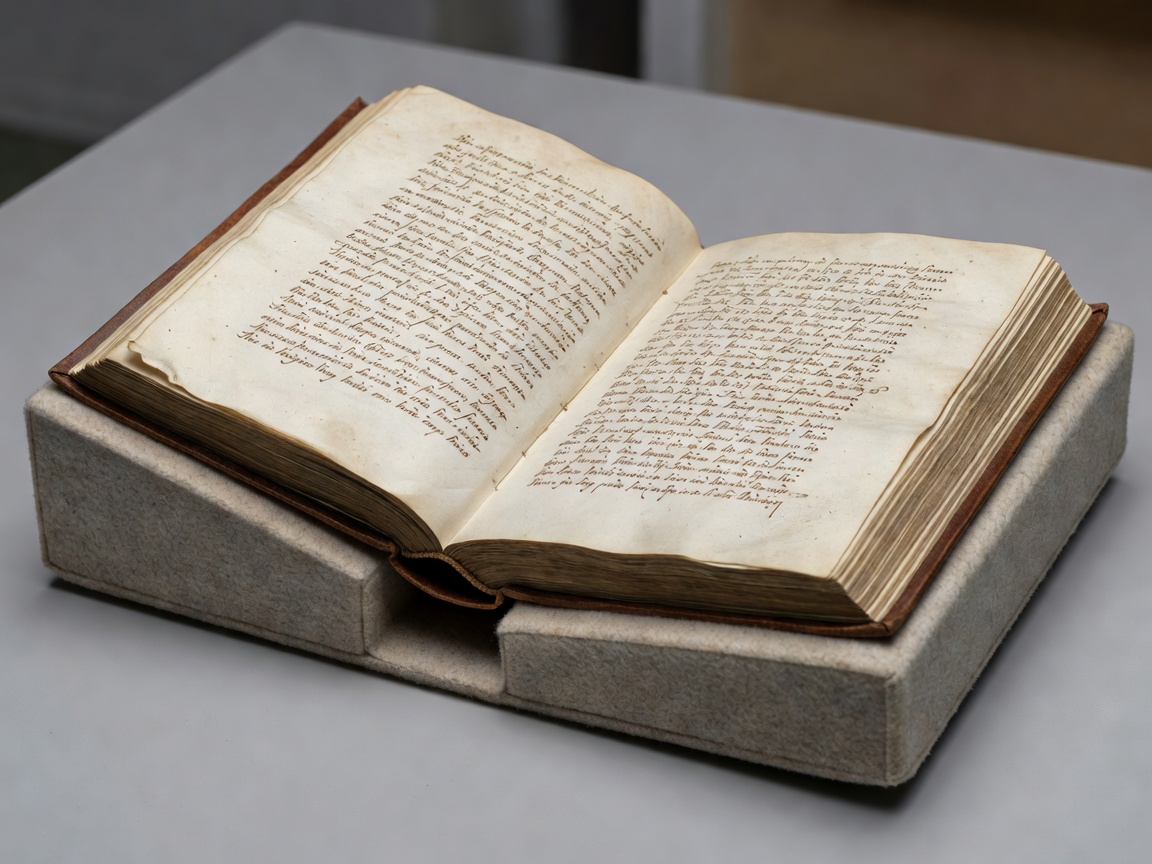
A bound volume has a gutter, cover, spine and page-turning limits. A page may curve toward the binding, and forcing it flat can cause damage. The intended capture method should therefore be selected after considering construction, condition, opening angle and the required visual information.
Manuscripts add further variation. Ink, pencil, annotations, folds, inserts and blank pages may all matter. A plan focused only on readable text can miss evidence in margins or on the reverse of a leaf.
Handling and preparation
Preparation should be conservative. Fragile bindings, loose pages, brittle paper, mould concerns or unstable media require an appropriate assessment and qualified handling. Do not improvise repairs, flattening or cleaning based on general online instructions.
A preparation record can note identifiers, existing order, restrictions and exceptions. It can also distinguish pages requiring special attention from pages suitable for a normal workflow. Minimal handling is often the soundest preservation choice.
Page capture and sequence
Page capture needs a consistent relationship between left and right pages, covers, spines, foldouts and blank leaves. The sequence should be understandable without relying on a person remembering how the physical object looked. A filename or identifier can carry volume and page relationships without embedding excessive descriptive text.
Oversized pages, foldouts and inserts should be treated as distinct capture cases. Their dimensions and position may require a separate record. The goal is not to force every item into one frame, but to make exceptions visible and intelligible.
Image quality and derivatives
A preservation-oriented master should retain information needed for future use. An access derivative can be prepared for reading, browsing or download. These are different purposes. Sharpening, contrast and colour adjustments should be controlled because excessive correction may remove subtle marks or create misleading edges.
For manuscripts, legibility is only one quality question. Tonal variation, ink density and paper colour can affect interpretation. A review should include page completeness, orientation, sequence, marginalia and the visibility of important physical features.
Metadata for volumes and leaves
Useful metadata may describe the volume, creator, title, date, language, repository identifier and content range. Page-level metadata is valuable when individual leaves need discovery, but it takes more planning. Decide whether the project needs a simple sequence, a structured table of contents or detailed item records.
Planning checklist
- Record binding, condition, format and opening constraints.
- Keep original sequence and document any exceptions.
- Include covers, blanks, foldouts and inserts where relevant.
- Separate preservation masters from access derivatives.
- Define page-level identifiers and review criteria.
Good for
This approach suits rare books, family manuscripts, administrative volumes, diaries, notebooks and bound records where context matters as much as text.
What to know
Capture quality cannot compensate for unsafe handling. Material that is unstable, valuable or difficult to open should be assessed by qualified personnel with suitable equipment. A digital copy is not a substitute for responsible physical custody.